
This article is brought to you by DiamondWatcher.com, which compares diamond prices across retailers.
VS1 vs VS2 Diamonds: What's the Real Difference (and Does It Matter?)
Introduction
VS1 and VS2 sit right next to each other on the clarity scale, and most of the time you can't tell them apart without a loupe. Both belong to the "Very Slightly Included" range. A grader found something at 10× magnification, but it's small.
So does the one-grade gap matter? This guide looks at what it changes for a buyer in terms of appearance, price, value and shopping strategy, and where the money VS1 costs extra could go instead.
How This Comparison Is Evaluated
We judged the two grades on things a buyer would notice or pay for.
We evaluate:
- How visible inclusions are when you look at the stone normally
- Typical inclusion size, type and location
- How much the grade moves the price
- How clarity plays against cut, shape and carat weight
- Resale and long-term confidence
We leave out differences you'd only find under high magnification, along with rare grading disputes and personal taste.
Quick Side-by-Side Overview
| Category | VS1 | VS2 |
|---|---|---|
| Clarity range | Very Slightly Included (higher) | Very Slightly Included (lower) |
| Inclusion visibility (10×) | Hard to find | Hard to find, but quicker than VS1 |
| Eye-clean likelihood | Virtually always | Usually, but not guaranteed |
| Typical price | Higher | Lower |
| Visual difference face-up | None in most cases | None in most cases |
What VS1 and VS2 Mean
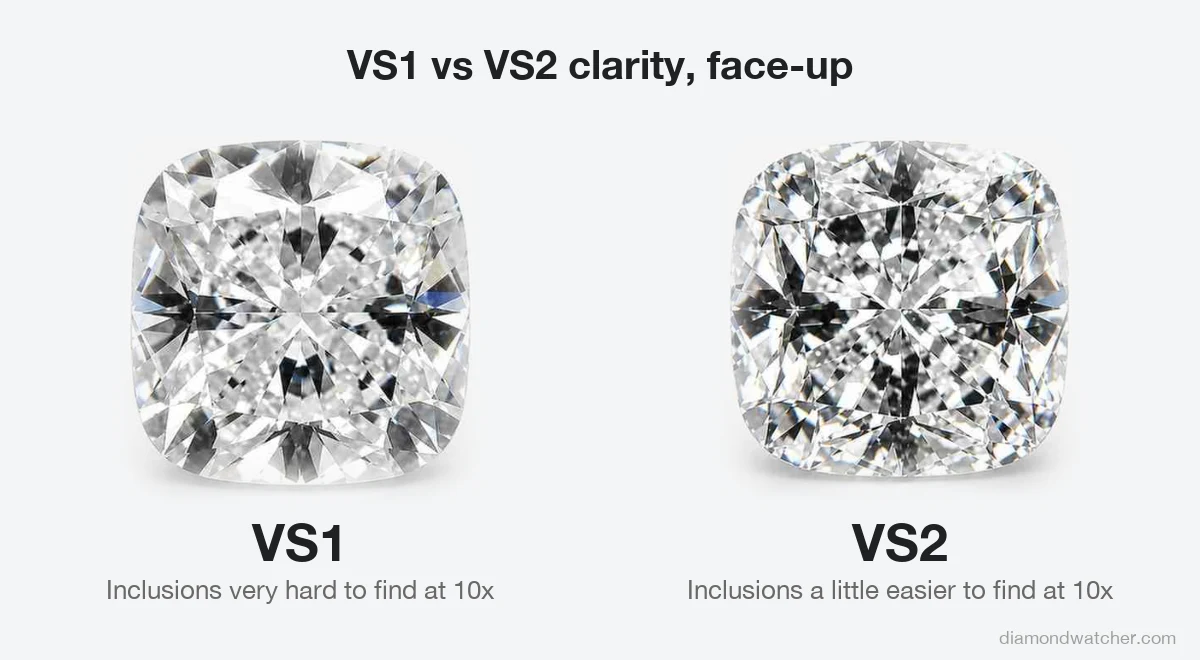
Both grades contain inclusions that graders consider minor. What separates them is how hard a trained grader has to look under 10× magnification.
VS1: The grader has to hunt. The inclusions are small, tucked away from the center, or low in contrast.
VS2: Still minor, but they turn up faster. They might be a little larger, more numerous, or closer to the middle of the stone.
For buyers, that makes it a technical distinction you'll rarely see once the diamond is set.
Eye-Clean Reality: What You Can See
Hold either grade 6 to 12 inches away and you'll almost certainly see a clean diamond. Here's how the two grades compare:
- VS1 diamonds are virtually always eye-clean.
- Most VS2 diamonds are eye-clean too, with a few exceptions.
The VS2s that aren't clean come from a few predictable places, so check these on video before you buy:
- Larger carat weights, where every inclusion is physically bigger
- Step cuts (emerald, asscher) and any stone with an inclusion under the center of the table
Impact on Diamond Pricing
VS1 carries a price premium over VS2, even when you can't see any difference.
- Expect VS1 to cost 5–15% more than a comparable VS2.
- When we pulled Blue Nile listings in October 2026 for 1.00-carat, G-color, Excellent-cut, GIA-graded natural rounds, the median VS1 cost $4,438 (59 stones) and the median VS2 cost $4,009 (47 stones). That's a gap of about $430, or 11%.
- You're paying for a rarer grade on the certificate and the reassurance that comes with it.
- That money could buy a better cut grade or a bit more carat weight, both of which you can see.
How Cut, Shape, and Size Change the Equation
Clarity is one input among several.
- Cut quality: A well-cut diamond returns enough light to mask small inclusions.
- Shape: Round, oval and cushion cuts scatter light across dozens of small facets and camouflage inclusions. The long, open facets of emerald and asscher cuts work like a window.
- Carat size: At the same grade, an inclusion in a 3-carat stone is physically bigger than one in a 1-carat stone and easier to spot.
That's why two VS2 diamonds with identical grading reports can look different face-up.
Resale and Long-Term Confidence
On the secondary market, both grades count as high clarity. VS1 may have a slight edge in perceived appeal, but resale prices follow cut quality, carat weight and market conditions far more closely, so if you never plan to sell, the difference is academic.
Which Is Better for Which Buyer?
VS1 may be better if you:
- Are buying a large diamond or a step cut
- Would rather not study photos and videos before buying
- Value peace of mind over getting the most for your money
Lean toward VS2 when you:
- Want the most visible quality per dollar
- Are buying a well-cut round, oval or cushion
- Don't mind checking the stone's images or video before checkout
Common Myths and Misconceptions
- "VS1 always looks better than VS2." Face-up, at a normal distance, the two look identical.
- "VS2 means visible flaws." A well-cut VS2 round, oval or cushion is usually eye-clean. Larger stones and step cuts are the exceptions.
- "Higher clarity is always better value." Once a stone is eye-clean, a higher clarity grade adds cost without changing what you see.
Final Takeaway
If you're shopping for a 1-carat round with an Excellent cut, VS2 is a sensible place to start, and the money you save on clarity can go toward cut or size. For a 2-carat emerald cut, start at VS1 or plan on watching the video closely.
How DiamondWatcher Helps You Compare in Practice
DiamondWatcher pulls VS1 and VS2 listings from multiple retailers into one search, so you can see what the clarity premium costs in real prices.
- Compare VS1 and VS2 diamonds side by side
- Spot clarity premiums that don't change how the stone looks
Explore live comparisons at https://diamondwatcher.com