
Diamond Size Chart & Guide
Compare carat sizes in mm, on the hand and by price
If you've never held a diamond, “1 carat” doesn't tell you much. Below, every common size is drawn to scale, on a finger at your ring size and in nine shapes, with what each one costs this month.
How big is a carat?
A carat is a unit of weight. One carat is 0.2 grams. What you see on a ring is the stone's width from above, and width only grows with the cube root of the weight.
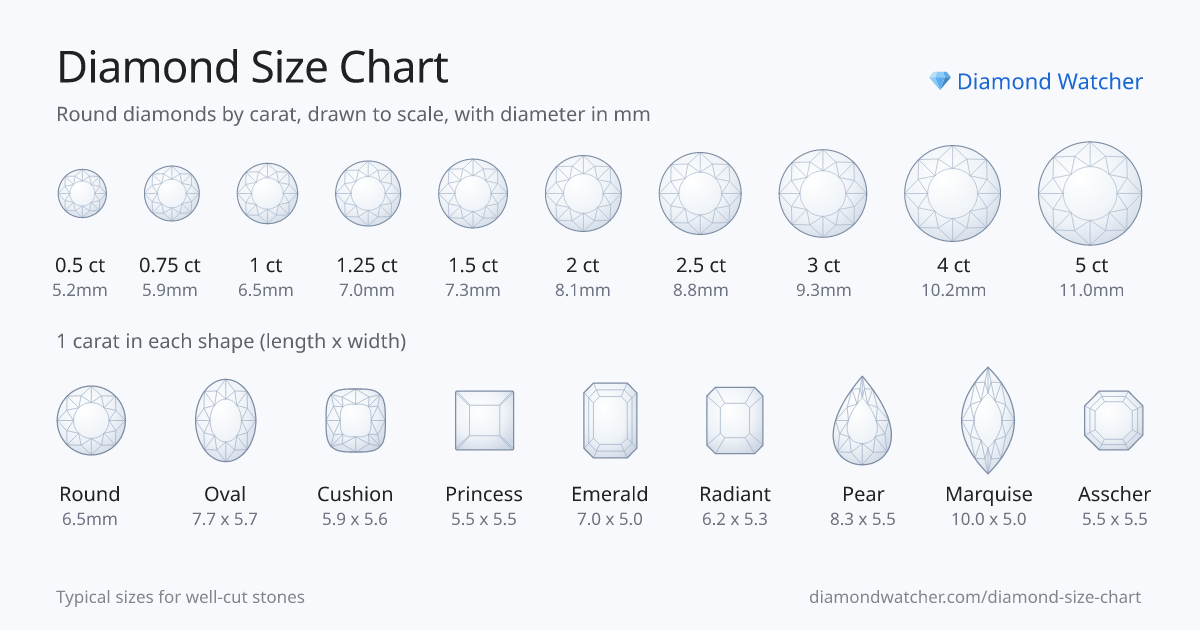
- 1 carat round: about 6.5mm across, close to a pencil eraser.
- Half carat: about 5.2mm, so a 1 carat is only 1.3mm wider.
- 2 carat: about 8.1mm, or 1.6mm wider than a 1 carat for twice the weight.
- Points: jewelers split a carat into 100 points, so a “50 pointer” is a half carat and a “75 pointer” is 0.75 carat.
The rest of the extra weight goes into depth, and once the stone is set you can't see its depth at all.
Diamond size chart (actual size)
Here are round diamonds from half a carat to 5 carats, side by side. To see the diamond size chart at actual size, switch to Actual size on my screen and hold a bank card up to calibrate it. The chart, and the finger tool further down, will then show each diamond at its real size.
| Carat | Round size | Width vs 1 carat | On a size 6 finger |
|---|---|---|---|
| 0.25 carat | 4.1mm | -37% | covers 25% of its width |
| 0.5 carat | 5.2mm | -20% | covers 31% of its width |
| 0.75 carat | 5.9mm | -9% | covers 36% of its width |
| 1 carat | 6.5mm | — | covers 39% of its width |
| 1.25 carat | 7.0mm | +8% | covers 42% of its width |
| 1.5 carat | 7.3mm | +14% | covers 45% of its width |
| 2 carat | 8.1mm | +26% | covers 49% of its width |
| 2.5 carat | 8.8mm | +36% | covers 53% of its width |
| 3 carat | 9.3mm | +45% | covers 57% of its width |
| 4 carat | 10.2mm | +59% | covers 62% of its width |
| 5 carat | 11.0mm | +71% | covers 67% of its width |
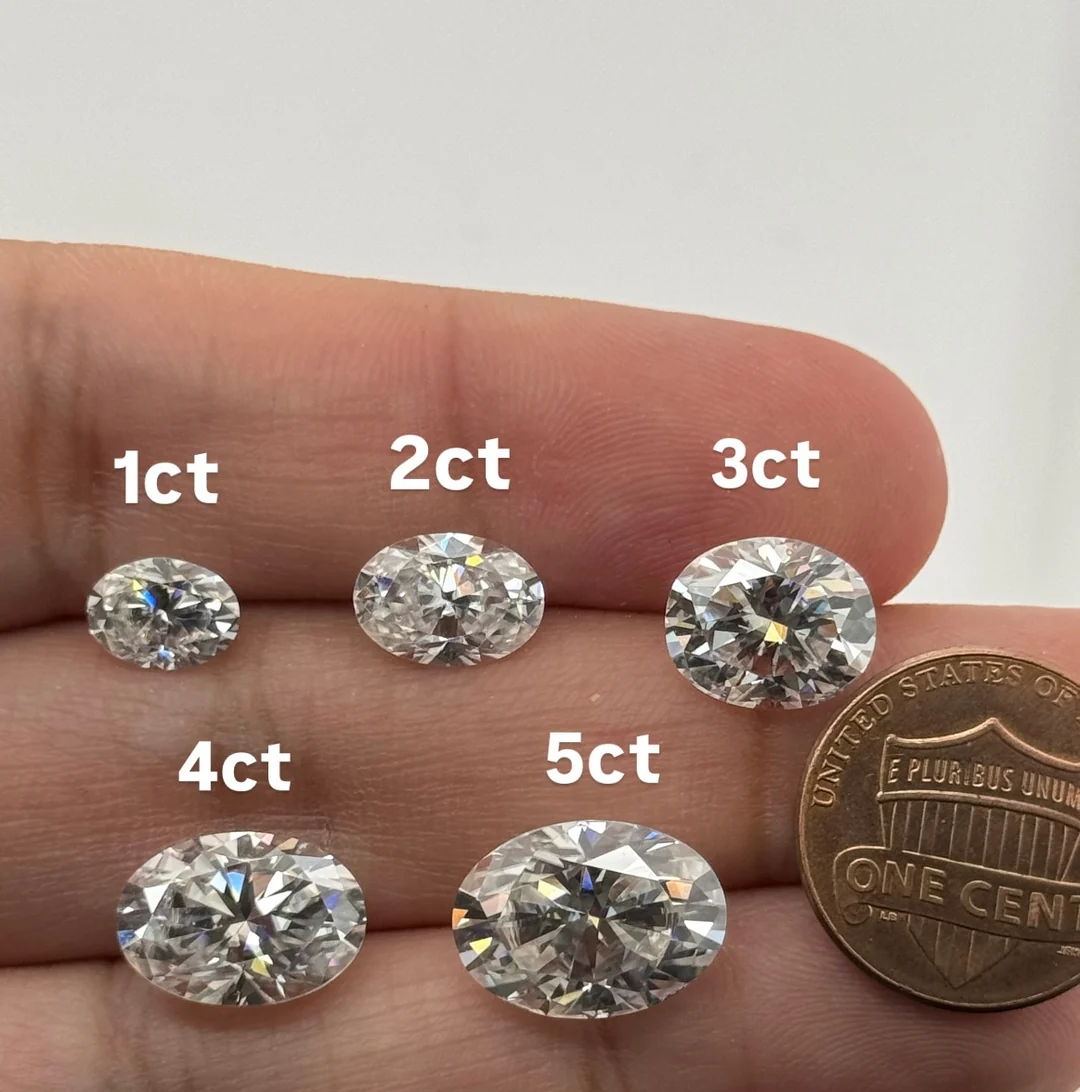
Diamond mm to carat
Know the size in millimeters and want the carat weight? For a well-cut round diamond, these are the approximate weights. A 6.5mm round is about 1 carat, and an 8mm round is just under 2.
| Round diameter | Approx. carat weight |
|---|---|
| 4.0mm | 0.24 ct |
| 4.5mm | 0.34 ct |
| 5.0mm | 0.47 ct |
| 5.5mm | 0.62 ct |
| 6.0mm | 0.80 ct |
| 6.5mm | 1.02 ct |
| 7.0mm | 1.28 ct |
| 7.5mm | 1.57 ct |
| 8.0mm | 1.91 ct |
| 8.5mm | 2.29 ct |
| 9.0mm | 2.72 ct |
| 9.5mm | 3.20 ct |
| 10.0mm | 3.73 ct |
| 10.5mm | 4.31 ct |
| 11.0mm | 4.96 ct |
Cut moves these by a few points either way. A deep stone weighs more for its diameter and a shallow one less. For other shapes, use the table in the next section.
Diamond sizes by shape
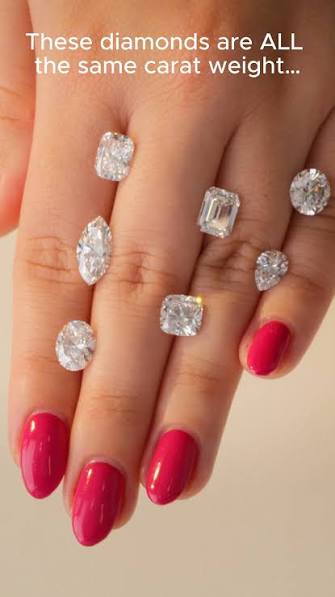
Shape changes how big a given weight looks. Pick a carat weight to see every shape drawn to scale.
Measured by area, no shape beats a round by more than about 5%. An oval looks bigger on the hand because it's longer.
- Marquise, pear and oval look biggest. A 1 carat oval is 7.7mm long against 6.5mm for a round, and a marquise runs to 10.0mm, so they cover more of the finger.
- Emerald and radiant come out about even with a round.
- Princess, cushion and asscher look smaller, because their corners and deeper bodies hold weight below the surface. An asscher has about 19% less face-up area than a round of the same weight.
Diamond size chart by shape (mm)
| Carat | Round | Oval | Cushion | Princess | Emerald | Radiant | Pear | Marquise | Asscher |
|---|---|---|---|---|---|---|---|---|---|
| 0.25 ct | 4.1 | 4.8 x 3.6 | 3.7 x 3.5 | 3.5 x 3.5 | 4.4 x 3.1 | 3.9 x 3.3 | 5.2 x 3.5 | 6.3 x 3.1 | 3.5 x 3.5 |
| 0.5 ct | 5.2 | 6.1 x 4.6 | 4.7 x 4.5 | 4.4 x 4.4 | 5.6 x 4.0 | 5.0 x 4.2 | 6.6 x 4.4 | 8.0 x 4.0 | 4.4 x 4.4 |
| 0.75 ct | 5.9 | 7.0 x 5.2 | 5.4 x 5.1 | 5.0 x 5.0 | 6.4 x 4.5 | 5.6 x 4.8 | 7.5 x 5.0 | 9.1 x 4.5 | 5.0 x 5.0 |
| 1 ct | 6.5 | 7.7 x 5.7 | 5.9 x 5.6 | 5.5 x 5.5 | 7.0 x 5.0 | 6.2 x 5.3 | 8.3 x 5.5 | 10.0 x 5.0 | 5.5 x 5.5 |
| 1.25 ct | 6.9 | 8.3 x 6.1 | 6.4 x 6.0 | 5.9 x 5.9 | 7.5 x 5.4 | 6.7 x 5.7 | 8.9 x 5.9 | 10.8 x 5.4 | 5.9 x 5.9 |
| 1.5 ct | 7.3 | 8.8 x 6.5 | 6.7 x 6.4 | 6.3 x 6.3 | 8.0 x 5.7 | 7.1 x 6.0 | 9.5 x 6.3 | 11.4 x 5.7 | 6.3 x 6.3 |
| 2 ct | 8.1 | 9.7 x 7.2 | 7.4 x 7.0 | 6.9 x 6.9 | 8.8 x 6.3 | 7.8 x 6.7 | 10.4 x 6.9 | 12.6 x 6.3 | 6.9 x 6.9 |
| 2.5 ct | 8.8 | 10.4 x 7.7 | 8.0 x 7.6 | 7.5 x 7.5 | 9.5 x 6.8 | 8.4 x 7.2 | 11.3 x 7.5 | 13.6 x 6.8 | 7.5 x 7.5 |
| 3 ct | 9.3 | 11.2 x 8.3 | 8.6 x 8.1 | 8.0 x 8.0 | 10.1 x 7.2 | 9.0 x 7.7 | 12.0 x 8.0 | 14.5 x 7.2 | 8.0 x 8.0 |
| 4 ct | 10.2 | 12.2 x 9.0 | 9.4 x 8.9 | 8.7 x 8.7 | 11.1 x 7.9 | 9.8 x 8.4 | 13.2 x 8.7 | 15.9 x 7.9 | 8.7 x 8.7 |
| 5 ct | 11.0 | 13.2 x 9.7 | 10.1 x 9.6 | 9.4 x 9.4 | 12.0 x 8.6 | 10.6 x 9.1 | 14.2 x 9.4 | 17.1 x 8.6 | 9.4 x 9.4 |
Typical dimensions in mm for a well-cut stone, length x width. Fancy shapes vary more than rounds because their proportions aren't standardized: a 1 carat oval can be anywhere from a chubby 7 x 6mm to a slim 8.5 x 5.3mm. Compare shapes in more depth in oval vs round, oval vs cushion and round vs princess.
How diamond sizes look on the hand
Finger size changes how big a diamond looks. Set the ring size, carat and shape below. If you calibrated your screen in the size chart, you can view it at actual size too.
- Diamond
- 6.5mm
- Finger width
- 16.5mm
- Covers
- 39% of the finger's width
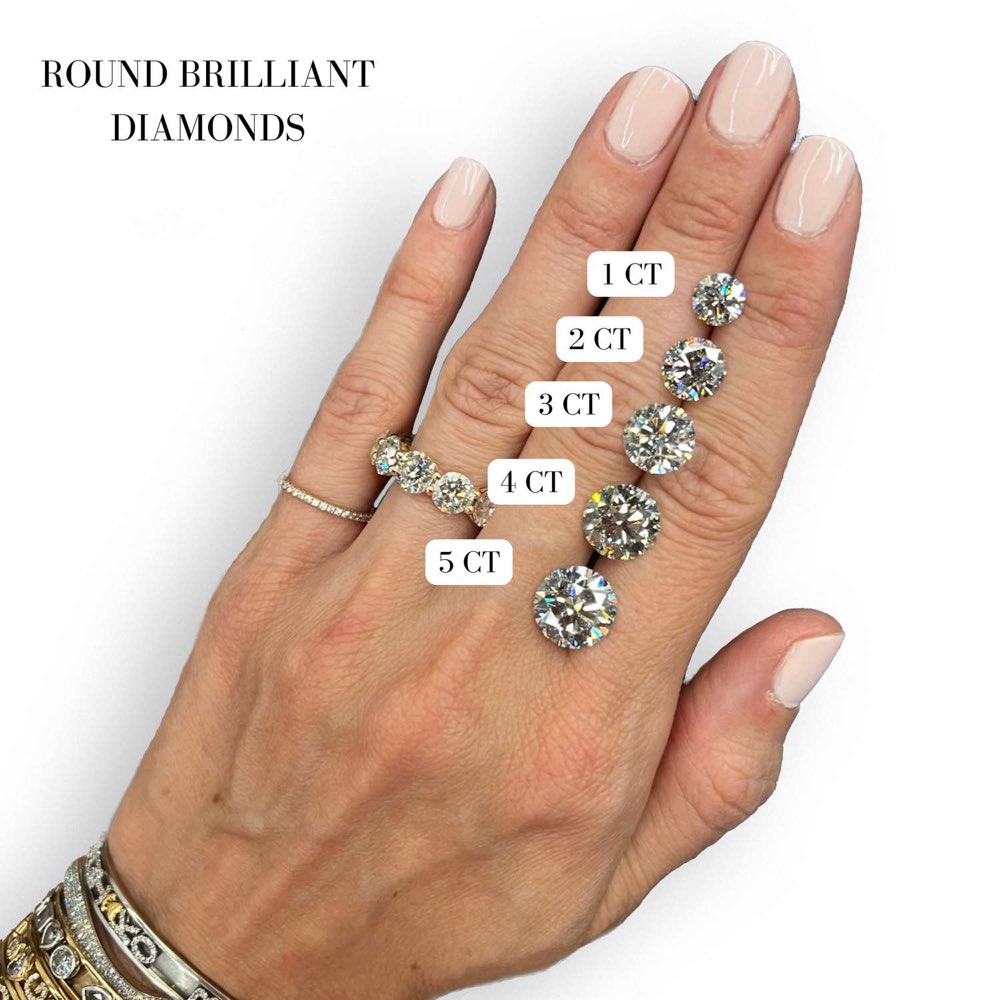
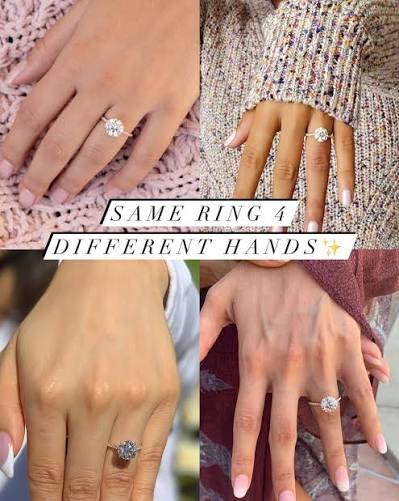
- A 1 carat round covers 43% of a size 4 finger's width but only 36% of a size 8, so slim fingers make any stone look bigger.
- On a size 6 finger, a round reaches about half the width (49%) at 2 carats.
- Ovals and pears run along the finger, which is why they fill more of the hand than their width suggests.
What makes a diamond look bigger (or smaller)
How cut changes face-up size
A diamond cut too deep carries extra weight underneath, where you can't see it. It faces up smaller than a well-cut stone of the same carat. One cut too shallow looks wider but leaks light and can look glassy.
Check total depth on the certificate. For a round, aim for roughly 59 to 63%. The too-deep stone in the drawing is 6.1mm across, the width of a well-cut 0.85 carat. Our guide to diamond certificates explains where to find it.
Setting
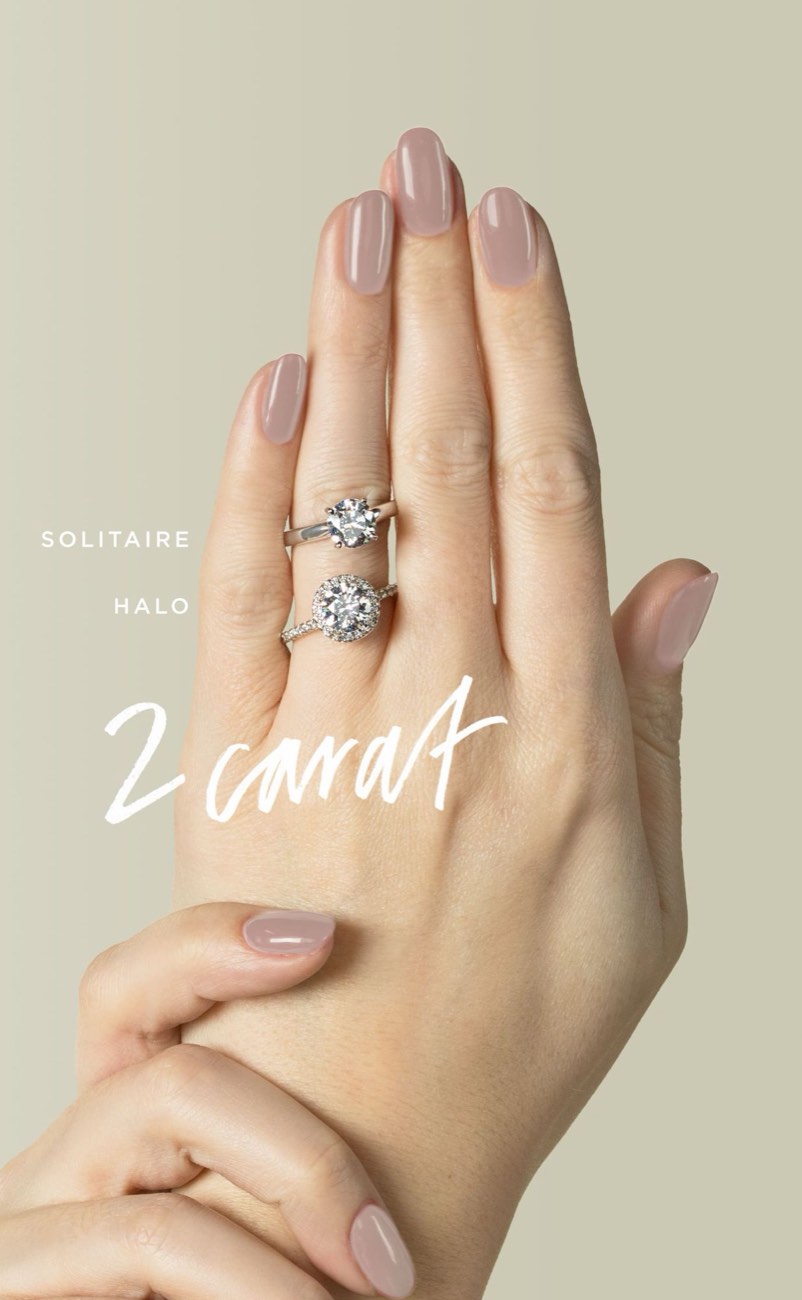
- Halo: a ring of small diamonds around the center adds roughly 2 to 3mm to the overall width. Try it in the finger tool above.
- Thin band: a 1.5 to 2mm band makes the center stone look bigger by contrast, and a chunky band of 3mm or more shrinks it.
- Prongs: white metal prongs blend into the stone's edge. Six prongs instead of four make a round look slightly larger and rounder.
- Bezel: a metal rim around the stone protects it and adds a little visual width, though it covers some of the sparkle.
Carat total weight (ctw)
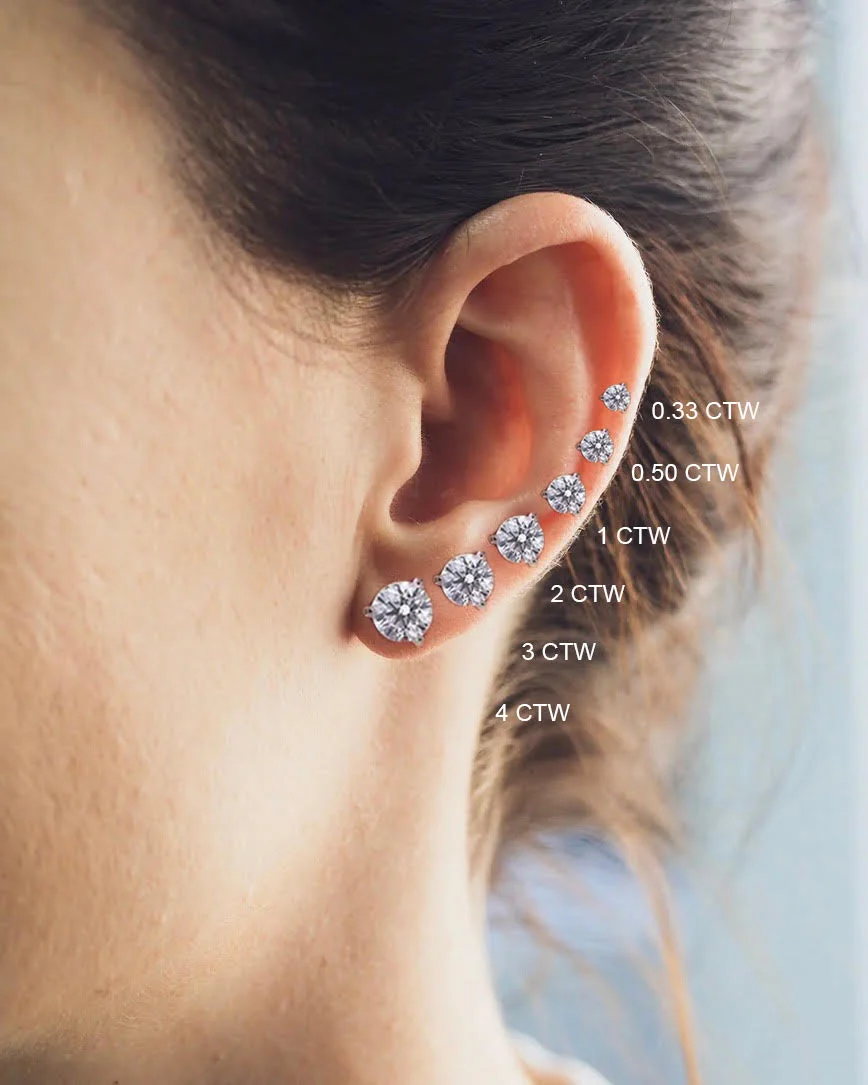
“ctw” (or “tw”) is the weight of every diamond in the piece added together. A “1 carat” halo ring or pair of earrings usually doesn't contain a 1 carat diamond.
- Stud earrings are almost always sold by total weight, so “1 ctw studs” are two half carats, each about 5.2mm.
- Halo and three-stone rings count the side stones too. The center stone's own weight is on its certificate.
- A 1 ctw halo ring costs far less than a 1 carat solitaire, since price depends mostly on the largest stone.
Diamond price by size
For natural diamonds, each extra carat costs more than the last. In October 2026, a 3 carat natural round (G / VS1) had a median price of $51,157. That's 15 times the $3,419 median for a 1 carat, for three times the weight. Lab-grown went from $350 at 1 carat to $1,819 at 3.
| Carat | Natural | Lab-grown | Natural per carat |
|---|---|---|---|
| 0.5 carat | $887 | $188 | $1,775 |
| 1 carat | $3,419 | $350 | $3,419 |
| 1.5 carat | $8,763 | $613 | $5,842 |
| 2 carat | $19,910 | $798 | $9,955 |
| 3 carat | $51,157 | $1,819 | $17,052 |
Median prices for October 2026, round, G color, VS1 clarity, from Ritani, Blue Nile, Rare Carat, and Brilliance. We don't track 4 and 5 carat stones yet. Full breakdowns by shape and retailer are on the diamond prices by carat pages.
What your budget buys
Roughly the biggest round G / VS1 diamond each budget gets you, based on the median prices above.
| Budget | Natural | Lab-grown |
|---|---|---|
| $1,000 | about 0.55 ct | about 2.25 ct |
| $2,500 | about 0.85 ct | 3 ct or more |
| $5,000 | about 1.2 ct | 3 ct or more |
| $10,000 | about 1.55 ct | 3 ct or more |
| $20,000 | about 2 ct | 3 ct or more |
Half the stones at each size sell for less than the median, so shopping around stretches these further. Dropping to H color or VS2 clarity does too. See G vs H and VS1 vs VS2.
Buy just under a round number
Natural diamonds jump in price at popular weights like 1.00, 1.50 and 2.00 carats. In October 2026, a 0.95 carat round had a median of $3,225 against $3,419 at 1.00 carat, 6% less for a stone about 0.1mm narrower, which you won't see once it's set. We track this jump every month on the diamond price index.
Choosing a diamond size
Here's how each size comes across on a size 6 finger.
| Size | How it looks | Often chosen for |
|---|---|---|
| 0.5 carat | Delicate. Easy to see, but small next to the band. | Stud earrings, slim settings, tighter budgets |
| 1 carat | The classic size. Clearly a diamond ring without looking big. | Engagement rings |
| 1.5 carat | Noticeably fuller than 1 carat, about 7.3mm across. | Engagement rings |
| 2 carat | Big. Covers about half the finger's width. | Engagement rings, statement studs |
| 3 carat | Very big. Well over half the finger at 9.3mm. | Statement rings |
| 4 to 5 carat | Cocktail-ring size, 10.2 to 11.0mm across. | Statement and cocktail rings |
Picking your size
- Set the finger tool above to the wearer's ring size before you settle on a carat weight.
- Weigh size against grade. For the same money, a clean-looking H / VS2 at 1.2 carats usually looks better than a G / VS1 at 1.0.
- An oval gives you more length on the finger for the same weight, at about the same price as a round.
- Bigger stones sit higher and catch on sleeves and gloves. A lower setting helps.
- If size matters most, look at lab-grown. Our natural vs lab-grown comparison covers what you give up.